


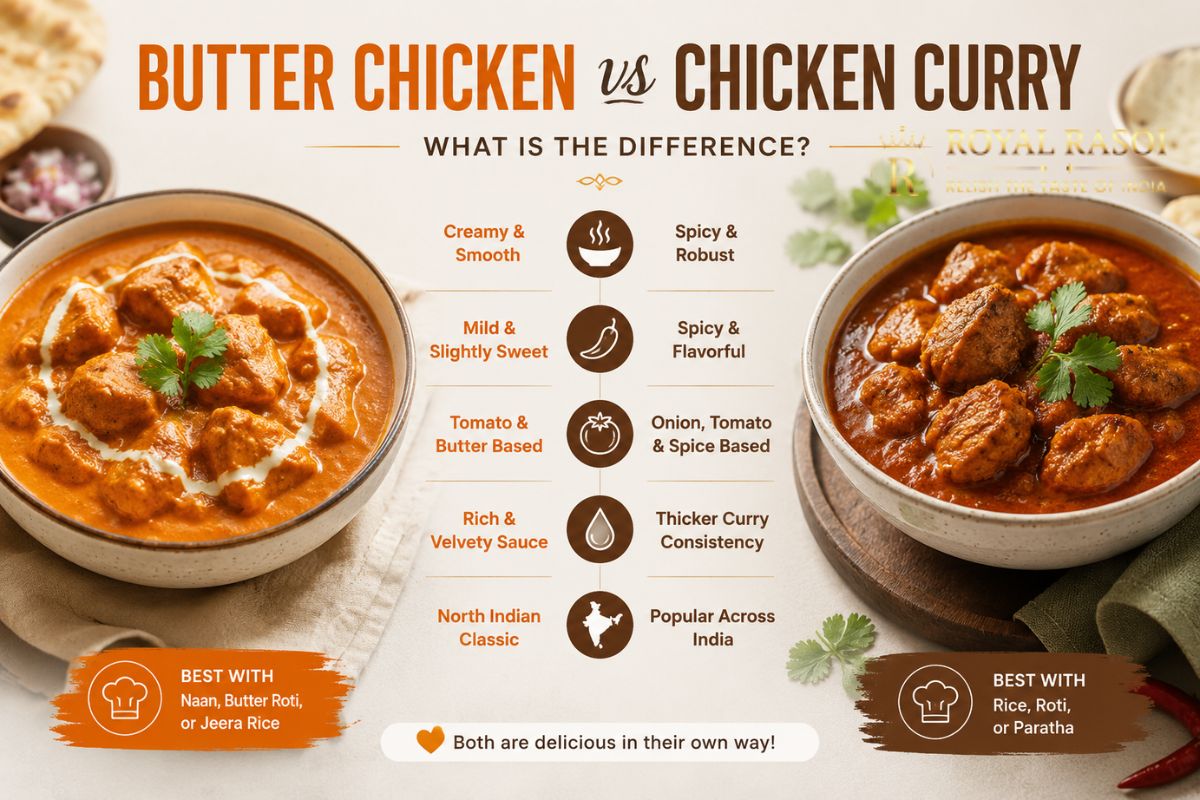
Although butter chicken and chicken curry originate from North Indian cuisine, they are very different in terms of their preparation. While making butter chicken, firstly, the chicken is prepared by marinating it with tandoori spices. Then the chicken is grilled and cooked in a creamy tomato sauce. The outcome of the dish is delicious and slightly sweet in taste, with very few heat levels.
In contrast, chicken curry makes direct use of the raw chicken; the pieces of chicken are combined with spices. The flavor of chicken curry is much more intense than the flavor of butter chicken. If you want to try chicken curry then you should know that both dishes are quite common in Hanoi restaurant menus.
Key takeaways
- Butter chicken employs the use of tandoori chicken, and curry, unlike butter, is made from raw chicken and spices.
- While butter chicken has a mild and creamy taste, chicken curry, on the other hand, tastes spicy.
- Butter chicken has a higher fat content; chicken curry on the other hand, usually has fewer calories.
- Always opt for places that prepare their gravy from scratch when looking for authentic butter chicken.
What is butter chicken?
Butter chicken, or murgh makhani, is a dish that started in Delhi in the late 1940s. The Goel family created this dish to ensure that leftover tandoori chicken did not dry out. The chicken is made in a creamy gravy containing butter, tomatoes, and cream, and became a global hit.
What makes this dish different is the method of cooking. The chicken is marinated in yogurt and spices, and then cooked in a tandoor. After that, the chicken is transferred to a separate gravy of tomatoes, butter, cream, ginger, garlic, and garam masala.
The end-result of the preparation is a dish that is rich, mildly spicy, creamy, and a bit sweet, making butter chicken a hit amongst both Indian and international food lovers.
What is chicken curry?
The name chicken curry is used generically for numerous dishes that are found throughout India. Unlike butter chicken, it does not follow one fixed recipe. Popular options include chicken curry from Punjab, Kerala and Andhra.
The most basic technique is straightforward. Onions, tomatoes, ginger, garlic and spices are used to cook raw chicken. Then, it simmers until the gravy has thickened and the chicken is tender.
Cream or tandoor-cooking is not typical in a chicken curry. The gravy tends to be more savory, thinner and spicier than that of butter chicken. It also varies in flavor from area to area. Coconut milk is used in South Indian recipes and mustard oil in Bengali recipes. Onion, tomato and spices are typically used in the Punjabi versions.
Chicken curry may be a good option for those that are seeking authentic curry restaurant Hanoi. It is flavoured according to the quality of spices used and the method of cooking.
Butter chicken vs chicken curry: key differences
| Feature | Butter Chicken | Chicken Curry |
|---|---|---|
| Cooking method | Chicken grilled first, then simmered in gravy | Raw chicken cooked directly in the sauce |
| Texture | Smooth, creamy, thick | Thinner, more rustic, oil separates on top |
| Spice level | Mild to medium | Medium to high, varies by region |
| Key ingredients | Butter, cream, tomato, tandoori chicken | Onion, tomato, whole spices, no cream |
| Flavor profile | Sweet-savory, rounded | Sharp, tangy, spice-forward |
| Best for | First-time Indian food eaters | Diners who want traditional heat and depth |
| Calories (approx. per 100g) | 115–140 kcal | 90–110 kcal |
The numbers in that last row aren't fixed. Recipes vary by kitchen. But as a general pattern, butter chicken sits noticeably higher because of the added fat from butter and cream, while a typical onion-tomato chicken curry stays leaner.
Nutritional differences explained
Butter chicken's calorie count comes almost entirely from the gravy, not the chicken itself. A standard restaurant portion (roughly 240–250g) commonly lands between 400 and 600 calories once you factor in the butter, cream, and any added sugar to balance the tomato's acidity. Protein content is moderate, around 10–13g per 100g, since the sauce dilutes the meat-to-liquid ratio.
However, chicken curry, without the dairy, generally comes in lighter per serving. The exact number depends heavily on how much oil the cook uses, since some regional styles (particularly South Indian preparations with coconut milk) can actually rival butter chicken in richness. As a rule of thumb: if a curry has no cream and a thinner, oilier sauce, it's probably the lower-calorie option between the two. Neither dish is particularly low in sodium, since both rely on salt and concentrated spice pastes for flavor. If you are looking for the best curry then North Indian restaurants in Hanoi will never disappoint you.
Common mistakes people make
A few misconceptions come up constantly when people compare these two dishes.
- Assuming butter chicken is "curry with butter added"- It's a distinct preparation built around the tandoor step. Skipping that step and just adding butter to a regular curry produces something closer to a shortcut than the real dish.
- Ordering butter chicken expecting spice- It's meant to be mild. If you want heat, chicken curry or a vindaloo is the better order.
- Judging a restaurant by butter chicken alone- Because it's forgiving to make (cream and sugar cover a lot of flaws), it's not the best dish to judge a kitchen's skill by. Chicken curry, with its exposed spice blend, is a more honest test.
- Thinking "chicken curry" means one fixed recipe- It's a category, not a single dish. Expect real variation from one restaurant to the next, even within India.
How to choose between them when dining out?
If you're new to Indian food or dining with people who are spice-averse, butter chicken is the safer opener. It pairs well with naan or rice and rarely disappoints, even at a mediocre kitchen, because the cream smooths over most inconsistencies.
If you've had Indian food before and want something closer to what's actually cooked in Indian homes, order the chicken curry instead. It tells you more about the kitchen: how fresh the spices are, whether the onions are cooked down properly, whether the heat is balanced or just harsh. When you're scouting the best place for Indian curry in Hanoi, this is the dish to order on a first visit, not butter chicken, precisely because it's harder to disguise a weak kitchen behind it.
Finding the Hanoi best butter chicken restaurant
Hanoi's Indian food scene has grown steadily, and quality now varies a lot between kitchens that make their gravies from scratch and ones that rely on pre-mixed pastes to save time. A few signs separate the two. Fresh butter chicken gravy has visible texture from the tomato and a faint smell of char from the tandoor-grilled chicken. Pre-mixed versions tend to taste uniformly sweet, with a flatter, one-note flavor regardless of what else is on the menu.
Moreover, Royal Rasoi, a north Indian restaurant in Hanoi, makes its butter chicken with chicken grilled in-house before it goes into the gravy. That's the traditional method, not the shortcut. It's the detail worth asking about at any place claiming to be the best butter chicken restaurant in Hanoi: whether the chicken is actually tandoor-cooked first, or just simmered raw in a butter-heavy sauce and marketed the same way.
Expert insights
The biggest tell isn't the menu description. It's the color and consistency of the gravy. Butter chicken gravy that looks uniformly orange and glossy, almost like it came from a can, usually did. A gravy with visible flecks of tomato, a slightly uneven color, and a thinner sheen of butter on top is a better sign of a from-scratch kitchen. The same logic applies to chicken curry: if the oil hasn't separated slightly on the surface, it likely wasn't simmered long enough to develop real depth.
Conclusion
Butter chicken and chicken curry aren't competing versions of the same dish. They're different techniques that happen to use the same main ingredient. Butter chicken is built for comfort and approachability; chicken curry is built for depth and regional character. Knowing the difference makes it easier to order what you actually want, and to judge a restaurant fairly instead of comparing a rich, forgiving dish against a leaner, more exposed one. If you're in Hanoi and want to taste both done properly, Royal Rasoi is worth visiting to compare the two side by side and see the difference for yourself.
Frequently asked questions
-
Is butter chicken the same as chicken curry?
No. Butter chicken uses pre-grilled tandoori chicken in a butter-tomato-cream gravy, while chicken curry cooks raw chicken directly in a spiced onion-tomato sauce with no cream involved. -
Which is spicier, butter chicken or chicken curry?
Chicken curry is generally spicier. Butter chicken is deliberately mild and creamy, made to appeal to a wide range of palates rather than deliver heat. -
Is butter chicken healthier than chicken curry?
Not usually. Butter chicken tends to be higher in calories and fat due to the butter and cream, while chicken curry is typically leaner, though this varies by recipe. -
What makes a restaurant an authentic curry restaurant Hanoi diners can trust?
Look for freshly ground spice blends, gravies made in-house, and chicken curry that shows regional character rather than a single generic recipe used for every dish. -
Can butter chicken be made without cream?
Some lighter versions swap cream for cashew paste or yogurt, but traditional butter chicken relies on both butter and cream for its signature texture and richness. -
Why does chicken curry taste different at every restaurant?
Because "chicken curry" isn't one fixed recipe. It covers many regional Indian styles, each using different spice ratios, cooking oils, and techniques. -
What should I order first at a north Indian restaurant in Hanoi?
Butter chicken is the safer first order for spice-sensitive diners. Chicken curry gives a more accurate read on the kitchen's actual cooking skill. -
Does butter chicken always use tandoori chicken?
Traditionally yes. Some shortcut versions simmer raw chicken directly in the gravy, which changes the texture and skips the smoky flavor tandoori cooking adds. -
How do I know I've found the best place for Indian curry in Hanoi?
Order the plain chicken curry, not butter chicken. A kitchen that gets the spice balance right on that dish is usually reliable across the rest of the menu too.