-


-
 Royal Indian Elegance DiningAuthentic Indian Restaurant in Hanoi at Grand Plaza Hotel
 -
 A Royal Taste of India,Now in the Heart of Hanoi.
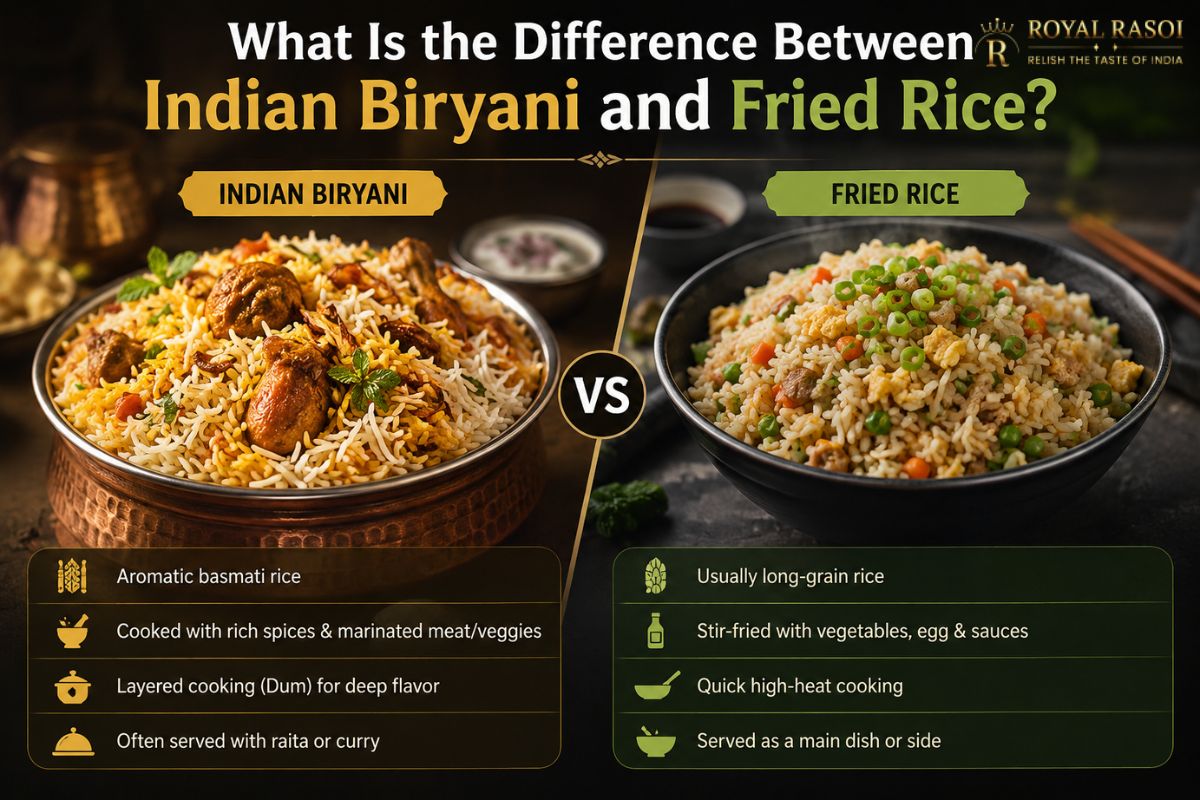
What Is the Difference Between Indian Biryani and Fried Rice?
Although Biryani and fried rice are both rice dishes, their similarities end right there. Biryani has layers in the preparation and has to be slow-cooked. Marinated meat, fish, and vegetables, with raw or semi-cooked rice, are combined in a sealed pot and cooked with minimal heat. The heat enables the rice to absorb the meat juices, saffron, and whole spices. On the other hand, fried rice uses well-cooked rice, which is made by tossing already cooked and cooled rice in hot oil with soy sauce, vegetables, and eggs in a wok.
One preparation makes use of layering while the other is prepared with high heat. Biryani makes use of spices like cardamom, cinnamon, and saffron, while fried rice makes use of garlic, soy sauce, and sesame oil. If you want to have authentic biryani when looking for Indian restaurants in Hanoi, the dish should be served with separate, elongated rice grains, rather than the uniform color that comes from soy sauce.
Key takeaways
- Biryani is cooked on low in a closed container, while fried rice is made over high fire.
- Biryani utilizes long-grained basmati rice and whole spices; fried rice incorporates soy sauce in its preparation.
- Biryani showcases influences from Persia and the Mughal Empire, whereas fried rice has roots in China.
- A classic North Indian eatery located in Hanoi serves traditional biryani.
What is biryani actually?
Biryani is an exquisitely layered rice dish. The meats, whether chicken, mutton, or seafood, are cooked separately before being skewered with partially cooked basmati rice in a pot. The pot is sealed using a dough that is crusted around the lid, and then put on a fire so that the rice cooks.
This type of cooking is referred to as “dum cooking.” This makes sure the biryani grains do not get stuck together into a lump and become bland. The rice at the bottom absorbs more of the flavor of the meat. The rice at the top receives more of the aroma of saffron and fried onions, ensuring that every bite of the dish has a unique taste.
However, the deliciousness of biryani is based on the preparation that is done before sealing the pot, such as fried onions or birista, whole spices like green cardamom, cloves, bay leaf, cinnamon, and saffron that have been soaked in warm milk. These ingredients are a must if you want to prepare biryani authentically. If you don’t carry out the dum step, the food is basically pulao, not biryani.
What is fried rice actually?
Fried rice is stir-fried, meaning the cooking technique is just as important as ingredients. The best rice is day-old, somewhat dried out, which goes into a hot wok with cooking oil. The other ingredients that are continuously tossed with it include garlic, egg, vegetables, and a sauce, which often contains soy sauce, as well as sometimes oyster or sesame oil.
The high heat creates fried rice’s characteristic slightly burnt edges and smoky flavor, known as “wok hei.” There is no layering part and no slow absorption of liquid. Everything happens really fast over strong heat, which is also a reason why rice made a day before is better than freshly cooked rice since it becomes sticky as soon as it hits hot oil.
Fried rice became popular and adapted to local palates wherever it went, like Indonesian nasi goreng, Thai khao pad, or Indian Chinese fried rice, where the stir-fry cooking principle remains the same, though flavors differ.
Biryani vs fried rice: side-by-side comparison
| Feature | Biryani | Fried Rice |
|---|---|---|
| Cooking method | Dum (sealed-pot steaming) | Stir-frying on high heat |
| Rice type | Long-grain basmati | Short or medium-grain, day-old |
| Core flavoring | Whole spices, saffron, fried onions | Soy sauce, garlic, sesame oil |
| Rice texture | Separate, fluffy, elongated grains | Slightly chewy with light char |
| Origin | Indian subcontinent (Persian/Mughal influence) | China (Yangzhou region) |
| Typical protein | Marinated mutton, chicken, egg, or seafood | Egg, chicken, shrimp, or vegetables |
| Cooking time | 45 minutes to a few hours | 10-15 minutes |
Cooking method: why it changes everything
The biggest difference between these two dishes isn't the spice list. It's how heat and moisture reach the rice. Biryani rice absorbs flavor slowly, in a closed environment, over low heat. Fried rice absorbs flavor fast, in an open wok, over very high heat.
Moreover, that's why substituting one method for the other never really works. Stir-fry biryani rice and the delicate saffron and meat-juice layering just disappears. Dum-cook fried rice ingredients and you lose the char and bite that define the dish. Each technique was built for a specific outcome, and skipping it changes what you end up with, not just how it tastes.
Regional variations worth knowing
Biryani isn't one dish. It's a family of regional styles. Hyderabadi biryani uses raw marinated meat layered with rice, known as kacchi style, and is known for its heat and depth. Lucknowi, or Awadhi, biryani is milder, with the meat cooked first (pakki style) and a more delicate spice profile. Kolkata biryani famously includes potato, a legacy of a nawab's exiled chef working with limited meat supplies.
Seafood versions deserve a separate mention. Prawn or fish biryani needs shorter marination and gentler layering than meat versions, since seafood cooks fast and turns rubbery if it sits too long under dum heat. If you're specifically looking for a seafood biryani restaurant Hanoi diners can rely on, ask whether the seafood goes in closer to the final layering stage. That timing detail is usually what separates a well-made seafood biryani from an overcooked one.
Where to find authentic biryani in Hanoi?
Hanoi's Indian food scene has grown enough that finding proper dum-cooked biryani, rather than a quick fried-rice-with-curry-powder substitute, takes a bit of local knowledge. Look for restaurants that list biryani by regional name, such as Hyderabadi, Lucknowi, or specifically labeled seafood biryani, rather than a single generic "biryani rice" entry. That's usually a sign the kitchen understands the dish's regional roots.
Therefore, menus that separate biryani from fried rice entirely, instead of grouping them under one "rice dishes" heading, also tend to reflect kitchens that treat each technique properly. Among the best Indian restaurants in Hanoi, the ones worth returning to are usually the smaller, specialist kitchens rather than large buffet-style venues. Dum cooking simply doesn't scale well to mass production.
North Indian cooking styles vs east asian stir-frying
Biryani sits within a broader North Indian and Mughlai cooking tradition built around slow cooking, dairy such as ghee, yogurt, and milk-soaked saffron, and whole spice blends rather than ground powders alone. That's a very different philosophy from East Asian stir-frying, which prizes speed, high heat, and sauce-based seasoning applied at the last minute.
If you want to taste this contrast directly, order biryani alongside a butter chicken or dal at a genuine North Indian restaurant in Hanoi and compare the cooking logic on the plate. Everything in the biryani is slow-built and spice-layered, finished together, rather than quickly assembled component by component.
Common mistakes people make comparing the two
A lot of people assume biryani is just Indian fried rice with curry powder added. It isn't. The cooking method alone rules that out. Others assume any rice dish with meat and spices counts as biryani, when skipping the dum step technically makes it pulao, a related but distinct dish.
However, on the fried rice side, a common mistake is using fresh, warm rice instead of day-old rice. That results in a soggy, clumpy dish instead of the light, separate grains fried rice is supposed to have. Restaurants that get this wrong are usually cutting corners on prep time, not on ingredients.
Expert tips for tasting the difference
Order both dishes side by side if you can. Notice the grain first. Biryani grains should be long and distinct, almost standing apart on the plate, while fried rice grains sit closer together with a light sear.
Smell before you eat. Biryani should carry a layered aroma: saffron, fried onion, whole spices that build as you eat through the layers. Fried rice smells sharper and more immediate, dominated by garlic, soy, and the wok itself.
If you're in Cau Giay and want to compare both properly in one sitting, look for a menu that offers true dum-style biryani next to a separate Indo-Chinese fried rice section. A kitchen confident enough to do both well, instead of blending the two into a single hybrid dish, usually knows what it's doing with either cuisine. That's a reasonable benchmark for best Indian food in Cau Giay if you're weighing a few options nearby.
Final thoughts
Biryani and fried rice both start with rice and end up on very different plates. One is built slowly, sealed, and layered with whole spices. The other is tossed fast over high heat with soy-based seasoning. Knowing the difference isn't just trivia. It changes what you should expect when you order, and it helps you spot a kitchen that actually understands the technique behind the dish rather than one serving a shortcut version.
At Royal Rasoi, biryani is still cooked the dum way, sealed, layered, and given the time it needs instead of being rushed to match a fried rice timeline. If you've only had the fast version until now, it's worth trying the slow one at least once.
Frequently asked questions
1. Is biryani a type of fried rice?
No. Biryani is dum-cooked in a sealed pot; fried rice is stir-fried in an open wok. The cooking method, not just the seasoning, is what makes them different dishes.
2. Which is spicier, biryani or fried rice?
Biryani is generally spicier because of whole spices like cardamom, cloves, and chili, though heat levels vary by regional style. Fried rice is typically milder, seasoned mainly with soy sauce and garlic.
3. Can I make biryani using the fried rice method?
Not really. Stir-frying skips the slow steam absorption that gives biryani its layered flavor and texture, so the result ends up closer to a spiced pulao than true biryani.
4. What rice is best for biryani versus fried rice?
Long-grain basmati works best for biryani because it stays separate and fluffy. Fried rice does better with short or medium-grain rice that's been cooked and cooled a day ahead.
5. Is seafood biryani different from meat biryani in preparation?
Yes. Seafood needs shorter marination and gentler, later-stage layering since it cooks faster and toughens if left under heat too long, unlike mutton or chicken.
6. Why does restaurant fried rice taste different from homemade fried rice?
Restaurant kitchens use very high-output burners that reach temperatures home stoves can't match, which produces the smoky "wok hei" flavor that's hard to replicate at home.
7. Is biryani healthier than fried rice?
It depends on preparation. Biryani often uses more ghee and richer marination, while fried rice can be lighter or heavier depending on oil and sauce quantity. Neither is automatically healthier without knowing the specifics.
8. What's the difference between biryani and pulao?
Pulao is cooked with less liquid absorption and fewer layering steps than biryani, and it's typically milder in spicing. Biryani involves the distinct dum-sealed layering that pulao skips.
9. How do I know if a biryani is authentic?
Look for separate, elongated grains, a strong whole-spice aroma, and visible layering of rice and meat rather than a uniformly mixed, one-color dish.
10. Where can I try authentic biryani and fried rice in one place in Hanoi?
Restaurants that list biryani separately from an Indo-Chinese fried rice menu, rather than folding both into one fusion dish, generally treat each technique with the care it needs.